Saturday, February 18, 2012

An Update On Man Cancer: Translating the Doctors


From the first moment my wife discovered she had breast cancer, there was a deafening silence from the men I know. Even ones whose wives, mothers or girlfriends had breast cancer seemed to have received a gag order from some Central Cancer Command and did little more than mumble about the experience. Not one to shut up for any known reason, I started this blog…(Sorry this is late today, but my new granddaughter was born on Thursday and we just moved the newly expanded family home this afternoon!)

My old friend who had a radical orchiectomy (http://breastcancerreaper.blogspot.com/2011/12/man-cancer-and-orchiectomy.html) faces a second operation next week. The procedure is a real mouthful so to speak because it doesn’t have a “common name”. He will be undergoing a retroperitoneal lymph node dissection or an RPLND – which really doesn’t do anything to make it easier to remember, because the letters might make up the word “ResPLeNDent”, but that’s not helpful and I doubt very much that it’s particularly descriptive of how my old friend will feel AFTER the procedure.

Not even Wikipedia has a simple explanation, so as I am wont to do, let’s see about translating the doctors:

Retro (= behind) peritoneal (= a sack that lines the area below the lungs and above the bladder that holds the kidneys, liver, parts of the large and small colon, most of the pancreas and the stomach) is surgery that tries to get at and remove abdominal lymph nodes.

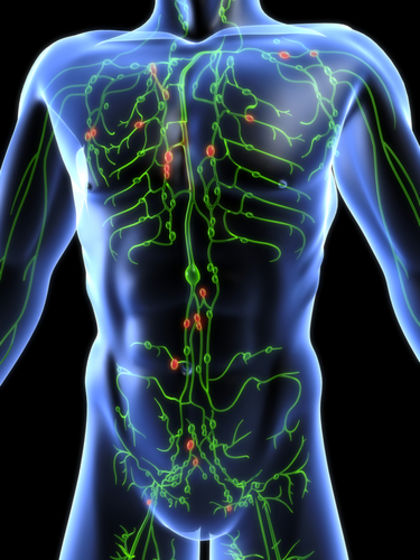
The nodes are outside of the sack that holds all the abdominal organs and lie against the INSIDE part of the spine. Lymph nodes are usually found at “bending points” like knees, ankles, arms, elbows, etc. Humans bend at the waist as well and a node in the abdomen pumps lymph through the body just as the others do. But it is close to the testicles and the nodes are the first to be attacked by cancer cells if they metastasize from there. Testicular cancer spreads in a well-known pattern, and these nodes are a primary landing site during spread of the disease.

 Doctors need to remove the nodes in order to treat testicular cancer, as well as help establish its exact stage and type. This has been done in the past by surgery so invasive that it required cutting a man open from the bottom of the sternum (middle of the rib cage) to below the belly button! There are dangers in this as well that I prefer not to go into.

But several doctors do the same surgery laparoscopically and while some surgeons consider it “less effective” others, it is less painful, runs fewer risks and joins the ranks of laparoscopic surgeries for repairing knees, shoulders, hernias and prostrates. It’s more expensive and detractors point out that not “all hospitals” have the capability of doing this, but it is far less incapacitating than the invasive older surgery.

Once the nodes are removed, an oncologist can examine the tissue to determine the extent of spread of the cancer. If no malignant tissue is found, the cancer may be more accurately considered as a stage I cancer, limited to the testicle and the orchiectomy may either be considered the “final solution” or they can follow it with chemotherapy or possibly radiation therapy. The low mortality and relapse rate with this procedure, as compared with the alternative, which is observation is the main reason my old friend has considered this as an alternative to the invasive surgery.

If you have testicular cancer – and any of us with testicles are susceptible. Warning signs are NOT LIMITED TO but may include: a lump or mass in either testicle, any enlargement or swelling of a testicle, a collection of fluid in the scrotum, a dull ache in the lower abdomen, back, or in the groin, a feeling of heaviness in the scrotum, discomfort or pain in a testicle or in the scrotum, enlargement or tenderness of the breasts. If you’re worried, go to your doctor! If you’re wondering, try the link below.


Saturday, February 11, 2012

Coming Up On One Year -- All About Me...


From the first moment my wife discovered she had breast cancer, there was a deafening silence from the men I know. Even ones whose wives, mothers or girlfriends had breast cancer seemed to have received a gag order from some Central Cancer Command and did little more than mumble about the experience. Not one to shut up for any known reason, I started this blog…

If you clicked on this to get information or find wisdom, you should click the return arrow and go back to your search. All you’re going to get here today are musings.

On March 18, 2011 Liz found out for sure that she had breast cancer. I detail the initial roller coaster in my first post (http://breastcancerreaper.blogspot.com/search/label/Introductions).

It’s now nearly a year later and shortly, we’re going to return to the hospital where it all started and talk with the breast cancer doctor who worked with Liz from the beginning.

My feelings run in ripples I feel in my muscles as I flash back and forth between the past and present. The biopsy day makes me shudder and my breathing catches in my throat.

The day of the mastectomy makes me feel numb as I can’t remember much except that I was surrounded by people who loved me – I wasn’t up to returning the love that day. I DO remember walking around the hospital in the cold with my sister. I remember walking around the hospital with Kathy. I remember Abbas coming to be with Mary. Other than those peculiar memories – and the bagels my sister brought. And the warm, grizzled redheaded embrace of my best male friend, Jon. See…it all comes in waves.

The choked conversations with my family after the biopsy.

The unholy terror of our first time at chemotherapy and the shock of the nurse dressed in goggles, mask, gloves, and gown injecting the red devil into Liz’ bloodstream to slaughter the invading cancer cells (http://breastcancerreaper.blogspot.com/2011/10/adriamycin-whats-it-do.html) and my thought of: “If it’s so dangerous you have to suit up like you’re going into an infectious disease ward, then what are you doing injecting into the heart of a cancer patient?!!!!!”

The repeat visits and watching Liz go from positive and chatting to lethargic and nearly unconscious were frightening. If I didn’t believe it was the effect of the drug trashing cancer cells, I would have refused to take her to the hospital again.

Ever.

For anything.

Then there was the guilt. Every one of the Neulasta shots (http://breastcancerreaper.blogspot.com/2011/11/neulasta-whats-it-do.html) cost $12,000. WHAT? How could I justify that? What were we doing to the poor? Shouldn’t I be doing something MORE to make the price come down? How could I explain this to the students I work with every day – some of whom are homeless? Can you put a price tag on a human life? What’s wrong with me? I shouldn’t even be THINKING about the price tag – but here I was, thinking about it! What kind of man am I to question this? It’s my WIFE of 25 years, for God’s sake!

But there I was, wondering about it. Struggling with it. Calling myself a douchebag.

So now it’s a year later and we’re going to go see the doctor again at the Breast Cancer Center. What’s he going to say? What’s next? Where do we go from here? Will life ever get back to normal?

*sigh*

See – no wisdom here. No hopeful pronouncements here. Only tentative thoughts of the future. Only breath holding. Only a closing of the eyes and a pretending to forget. Only a running of my hand through the baby-soft hair on Liz’ head. Only a sitting so close you can’t slip a hand between our thighs; only seated on opposite sides of the room, doing our own computer work and feeling guilty because I should be sitting so close you can’t slip a hand between our thighs because time is ALWAYS short, even for the granddaughter we’re waiting patiently for.

Maybe one thought, as trite as it sounds, as Disneyesque as it appears above: keep moving forward...

That’s what I’ll do.

Saturday, February 4, 2012

Lymphedema -- Another "For-the-Rest-of-Your-Life" Thing...


From the first moment my wife discovered she had breast cancer, there was a deafening silence from the men I know. Even ones whose wives, mothers or girlfriends had breast cancer seemed to have received a gag order from some Central Cancer Command and did little more than mumble about the experience. Not one to shut up for any known reason, I started this blog…

Once the surgery was over and the “main” healing begun, we talked with my wife’s cancer care team and they introduced us to lymphedema.

First of all, “What is lymphedema?”

Let’s begin with an overview of the body system affected by this. Lymph is a clear fluid that lies in between the cells of the body. It’s there to feed the cells and to carry away waste. It comes from the blood itself and (to put it as simply as possible), “leaks” out of the tiny vessels that carry blood. It leave the red blood cells behind and if it were not cleared out, it would cause a massive amount of swelling.

Another system of vessels call the lymphatic system, “vaccuums up” that lymph and carries it back to the heart.

HOWEVER, where the circulatory system as the heart to push the blood around, the lymphatic system HAS NO HEART!

The only way to lymph can move around is by you and I moving. The movement of our muscles presses the lymph into the collection spots called the lymph nodes. These nodes are a gathered at very specific points in our bodies – the places where we move the most, the joints. Behind the knees, in the groin, the elbows, the armpits, the neck is where you’ll find large clusters of nodes. In addition you can find nodes in the lungs, underneath the chest muscles, along the spine as well as numerous other places in the body.

These nodes not only collect lymph to pass it back to the heart, they are also places where white blood cells made in the bone marrow, thymus, spleen and tonsils are gathered to be redistributed through the bloodstream to fight disease in the body.

The nodes are vital in moving the lymph fluid around and when some are removed during a mastectomy, the ease with which lymph can be moved is weakened. Even though there are still nodes under the muscles and in places besides the nodes – and so removal doesn’t instantly STOP the movement of lymph – it does reduce how much lymph can be moved around.

You probably already know that white blood cells fight disease. They also fight infections as well. When you get a cut or have surgery, white blood cells are moved by the body through the blood stream to the wound and often times leave the bloodstream to fight the infection. Once the infection is past, the white blood cells need to be transported back to the heart to go back into the bloodstream again.

When nodes are removed through surgery (or other damage or illness), the process takes much longer to “clear out” the white blood cells and the other extra fluid that the wound or damage caused. Because blood never stops flowing at its regular rate, fluid is still NORMALLY leaking out between cells. When you add the normal fluid leakage to the extra fluid and white blood cells from an infection, you get too much fluid in one place. This is called lymphedema (lymph of course, is what we’ve been talking about here; “edema” is a Greek word that means “to swell”).

The second question is: “What can I do about it?”

Lymphedema is treated by pushing the extra fluid back to where it belongs by helping the muscles and lymph nodes that are missing. Often this involves using massage as well as a compression garment: “The most common treatments for lymphedema are a combination of manual compression lymphatic massage, compression garments or bandaging.” Regular exercise is also helpful (see last week’s article on exercise: http://breastcancerreaper.blogspot.com/2012/01/10-exercise-hints-for-cancer-folk-and.html for some pointers!)

This is very straightforward, does not appear in any of the reading I did to be something to PANIC about…it does however require an awareness of what’s happening in your body and how to deal with it!

Saturday, January 28, 2012

10 Exercise TIPS for Cancer Folk (and don’t forget the significant others!)


From the first moment my wife discovered she had breast cancer, there was a deafening silence from the men I know. Even ones whose wives, mothers or girlfriends had breast cancer seemed to have received a gag order from some Central Cancer Command and did little more than mumble about the experience. Not one to shut up for any known reason, I started this blog…


“You should just exercise! It will take away the stress! It will help you heal faster! Exercise will make you better!”

Cool.

Fine. Sign me up for the next Grandma’s Marathon! Running twenty-six miles should be good for at least one chemotherapy session, right?

Exercise…

What exactly does this mean? How do I turn “exercise is good for you” into something I can DO? Oh, and is the “exercise is good for you” mantra only for the loved one with cancer? What about me – who put on something over ten pounds during the chemo sessions and can’t seem to shake the weight now?

The answers to these questions a literally scattered all over the internet, so I’ll try and analyze and condense them here into TEN workable breast cancer treatment and after-treatment practical exercise tips (ALWAYS TALK TO OR CALL YOUR CANCER CARE CENTER BEFORE YOU START ANY KIND OF EXERCISE TO SEE IF IT’S SAFE FOR YOU):

1)      “‘You don't have to be Lance Armstrong,’ stresses Dr. Julia Rowland of the National Cancer Institute, speaking from a survivorship meeting this month that highlighted exercise research. ‘Walk the dog, play a little golf.’” Walk the dog, walk to the end of the block, walk somewhere. Several people recommended finding a neighborhood indoor mall that opens early and walk the perimeter before the stores open. Walk!

2)     “Researchers think exercising together may help both partners stick with it. They also are testing whether the shared activity improves both physical functioning and eases the strain that cancer puts on the caregiver and the marriage.” Walk with a loved one (in my case, ME! I should be walking and exercising WITH my wife. WALKING. Doing DANCE FEVER to an enjoyable music routine. Life weights – or cans of soup if you don’t have weights. A little weight lifted a number of times during a day counts as exercise! Hide the weight in your work locker or in a desk drawer – or leave it out and tell people what you’re doing. You will find a remarkable amount of support.

3)     “For example, Schmitz led a major study that found careful weight training can protect against lymphedema, reversing years of advice to coddle the at-risk arm…” See #2 – lift anything! (By the way, this is called resistance training – the weight “resists” being lifted.)

4)     “…at-home exercises with some muscle-strengthening, plus a better diet, could slow physical decline.” There are dozens of DVD exercise programs. If you can’t buy one, check one out from your local library or ask to borrow one from a local gym, YMCA or school. Do as much as you can, then stop. (See #1 above!) Also, lifting the DVD into the player is exercise! Here’s the address for a DVD specifically for breast cancer survivors: http://www.strengthandcourage.net/

5)     Arms at your side, hold a towel in both hands. Using the unaffected arm, pull the other behind the back. Alternate Pain is to be respected and the stretch should be held to the point of discomfort not pain .The stretches should be held from 5-10 seconds at first, gradually increasing the length of time. It’s better to do this several times during the day, rather than all at once. With arms bent (on either side of the head), hold a towel in both hands. Using the unaffected arm, pull the other behind the head.

6)      “If lymphedema is a concern, you…should be fitted with a sleeve which is worn while exercising especially when lifting weights. Progress…slowly and start with a light weight – ONE pound is just fine.”

7)     Walking and cycling are quite beneficial as are swimming, cross training, or aerobics. It is best to begin with a 5-10 minute walk to judge...if a long period is too much, multiple shorter aerobic sessions are fine. Your goal will be to gradually increase the time period engaged in aerobic exercise and to slowly increase your exercise tolerance.

8)    Doing yoga can provide flexibility benefits as well as instruction in stress reduction techniques that can prove beneficial. [I know nothing about yoga, so start with a library visit or a YouTube video: http://www.youtube.com/watch?v=H3vLZqPZxZE]

9)     Yep, I’m sayin’ it again: “Walking, a common fitness choice, offers the benefits of aerobic exercise without overly straining the body. According to a 2005 study in the Journal of the American Medical Association, the benefits of walking peak when a breast cancer patient or survivor walks 3 to 5 hours weekly at a pace of 2 to 3 miles per hour.”

10)  Find a swimming pool and join a waterobics class; if you can’t join a class, get this CD: http://www.maryessert.com/bcr.htm This site lists the exercises and exactly how to do them!


http://www.cdc.gov/nccdphp/dnpa/physical/pdf/PA_Intensity_table_2_1.pdf (A really, really LONG list of things you can do to exercise!)


Saturday, January 21, 2012

GUEST POST: David Haas -- Fight Cancer With Physical Fitness


When a cancer patient first finds out he or she has any form of cancer, skin cancer, liver cancer, colon cancer, breast cancer, mesothelioma, or any other type of cancer, one of their first questions is what they can do to help their body fight the disease. Conventional ideology by patients and cancer treatments staff, including doctors, was to rest and take it easy during diagnosis, treatment and remission stages. Yet recent studies have indicated that physical activity no matter what your stage of cancer can have tremendous health benefits.

According to the National Cancer Institute, physical activity is a critical component of something called energy balance, and not only does it increase energy levels, it can also reduce the risk of some cancers, like breast cancer and colon cancer.

Physical activity has the added benefit of improving overall quality of life and reducing fatigue. It is also associated with positive psychological effects that result from the knowledge of taking good care of one's body, the release of feel good chemicals like serotonin, and the hope of not giving-up.

Studies into the benefits of physical activity in those who have cancer have indicated a positive correlation between increased recurrence rates and chances of survival in those who were more active post-diagnosis.

Exercise also strengthens the body and increases its natural defense mechanisms. This helps the body withstand rigorous treatments like chemotherapy by reducing the side effects like nausea and fatigue, fights off any opportunistic infections and empowers the body to mend. It also helps reduce excessive body fats that are a risk factor for chronic diseases like heart disease. Other conditions that are positively affected by physical activity are cholesterol, diabetes and high blood pressure.

Finally, exercise also promotes good sleeping and this is especially beneficial to cancer patients as they bodies need rest. Therefore, contrary to conventional thoughts on resting which involved keeping sedimentary, good rest along with a host of other health benefits can result from keeping physically active. Therefore whether a patient was just diagnosed, is going through treatment or is in remission, physical activity is an important component of their weekly regimen. Exercise does not need to be intensive, even the smallest changes that keep one active like walking a dog or taking the stairs can make a difference. It is important to check with a doctor first before getting started.

David Haas is a cancer patient advocate and the Community Awareness Director for the Mesothelioma Cancer Alliance who writes and researches for the betterment of others.

Saturday, January 14, 2012

Metastatic Breast Cancer: Brain Cancer


From the first moment my wife discovered she had breast cancer, there was a deafening silence from the men I know. Even ones whose wives, mothers or girlfriends had breast cancer seemed to have received a gag order from some Central Cancer Command and did little more than mumble about the experience. Not one to shut up for any known reason, I started this blog…

The first question that comes to mind is, “Is a brain tumor the same as brain cancer?”

While I don’t usually go to Yahoo Ask for my medical information, I decided today to START there because the answerer is both an MD and clear:

“Interesting that you bring this up. Primary brain malignancies have always been called brain ‘tumors’ rather than ‘cancer of the brain’. Yet many are clearly cancerous, locally invasive, progressing malignancies. Strange the way people perceive words. If you tell patients they have a ‘tumor, it does not seem as ominous to them as saying they have ‘cancer’…there is confusion that many people have in regard to this topic. A person with lung carcinoma that has spread to the brain has lung cancer in the brain. It is not a brain cancer. It is still lung cancer that is growing in the brain area. A person with a glioblastoma multiforme has a brain tumor - but these are usually aggressive cancers. As for cures - that depends on the primary brain cancer/tumor type and the stage.
Interesting question regarding the semantics of this.”

Source(s): MD medical oncologist - cancer specialist doctor Spreedog, 2010 http://answers.yahoo.com/question/index?qid=20091114024633AADSsIx

This is in concordance with what I’ve already found out about bone cancer and lung cancer – when you have had breast cancer and is spreads (which is what Metastatic Breast Cancer is), you have breast cancer cells growing wild in the bones, liver, lungs, brain and various  other places.

So what happens? This seems to me to be a truly horrible kind of MBC because the brain is the seat of Human consciousness.

The writer here expresses this terror: “It was because of a few unusual symptoms, that several months ago I requested a brain scan. By the time the date arrived for the scan, the symptoms, along with my fears, had disappeared. Imagine my surprise when the next day my oncologist called to say that they had found 2 tiny spots on my brain. The news was devastating. While breast cancer is every woman’s nightmare, and metastasis is the nightmare of everyone who has breast cancer, brain metastasis is the nightmare of everyone who has metastatic disease. It was so frightening that I couldn’t speak to anyone about it. I could barely allow myself to think about it. None of this is news to you. You wonder how many tears you can actually shed. You wonder if you will ever feel like your old self again and if your friends and family will ever think of you in the same way. You wonder if you will lose the person you are. It is the most terrifying diagnosis anyone can have, even those of us who are used to bad news.”

What are the symptoms? Please keep in mind that the symptoms are DIFFERENT depending on where the cancer attacks first. Also, OTHER things can cause these symptoms. My wife works as a classroom aide with kindergartners – she gets headaches sometimes, as anyone would who tries to work with a room full of five-year-olds!

Symptoms include: “changes in the ability to think, understand and use words correctly; emotional changes; weakness; dizziness; seeing lights, seeing double, or narrowing of vision; problems with balance; seizures; nausea and vomiting; changes in smelling, taste, hearing. If any of these symptoms persist (that is, stick around for a while) like a headache that is worse in the morning, lasts for days, or recurs every day, then you’ll want to talk to your health care authority.

Once you report to the cancer care center or your doctor and there appears to be reason to suspect MBC-brain cancer, an MRI (magnetic resonance imaging) is the most effective technology for diagnosing breast cancer brain metastases. It does a better job in distinguishing a single metastasis from multiple metastases, which is an important factor in determining what kind of treatment a patient needs.

Unfortunately, treatment for MBC-brain cancer is problematic still. In m0st cases, whole brain radiation (which is exactly what it sounds like) is the first line of offense. There is good evidence that this treatment is effective almost half of the time in completely reversing the effects of the cancer. In MOST cases, it reduces the symptoms significantly. It is also a shorter-term treatment than the original chemotherapy with radiation doses given daily for 5-10 days (though this is sometimes spread over a longer period to lessen the side-effects.

At other times, the radiation is aimed from multiple directions at specific metastases. This has the advantage of fewer side-effects, but there is no clear EVIDENCE yet that this is as effective as whole brain radiation treatment.

Other, less common treatments include brain surgery (physical removal of the cancer), chemotherapy (not effective usually because the chemo can’t break through the barrier into the brain through the blood (called the blood-brain barrier); and a combination of the above.

Finally: “‘So much depends on the aggressiveness of your individual cancer, the time to recurrence from original diagnosis, any other metastases, and overall health—and, the number, location and size of the brain mets (metastases), and whether they are symptomatic or not,’  Patty observed. ‘I was so sure that I would die within 18 months of my first diagnosis with brain mets.  I readied for the time of my death. Now, I’ve had to revise things a few times.  I wonder if I hold some kind of record for brain MRI’s, having had them on average every two months for five years—that would be around thirty, with bad veins! I’ve had brain mets for five years and have been living with eight lesions for two and a half years.’”

Saturday, January 7, 2012

All Quiet On The Western Front


From the first moment my wife discovered she had breast cancer, there was a deafening silence from the men I know. Even ones whose wives, mothers or girlfriends had breast cancer seemed to have received a gag order from some Central Cancer Command and did little more than mumble about the experience. Not one to shut up for any known reason, I started this blog…

Like most of you, I recognized this blog title as the name of an old book – maybe an old war movie.

I’d assumed it was about World War II, I suppose because that’s the war I’m “familiar” with.

It’s neither and it fits even better my current state of mind.

The main characters of the book are German boys sent to the Western Front – the leading edge of the German invasion into France and a place where the war essentially “stopped”. From its closest approach to Paris in September of 1914 to the position the Allies pushed them back to 1916 and where the war stagnated, little of import happened there. That is the thrust of the book. From the ground, when you are young and the horrors of war can’t possibly match anything you’ve ever seen, “nothing happens”.

The problem is that while nothing appears to change on the Front, nothing also changes back home. When you return home, while everyone is glad to see you and everything is just as you left it – you are no longer the same person who went to war. You have seen things you can’t even explain to those who remained behind.

In the book, ALL QUIET ON THE WESTERN FRONT, the main character, Paul Bäumer is a soldier who—urged on by his school teacher—joined the German army shortly after the war began, and who is all of nineteen years old. Some time later, Paul visits on leave to his home which highlights the cost of the war on his psyche. The town has not changed since he went off to war; however, he finds that he does ‘not belong here anymore, it is a foreign world.’ He feels disconnected from most of the townspeople…not understanding ‘that a man cannot talk of such things.’”

I can understand something of that feeling.

While the breast cancer threat has disappeared, we no longer have to go to chemotherapy sessions and the imminence of the cancer has seemingly faded; it’s not gone from my mind. I am still worried. I still wonder. When I rub my wife’s head, touching the soft hairs that have grown back in the months since chemo ended, everything seems so peaceful.

Everything seems “over”.

But it’s not and I can’t explain that it’s NOT over to people who only ask occasionally now, “How’s your wife?” Some of it is that I don’t have the time to talk about my fears of MBC or the long-term effects of the estrogen-blocking drug she has to take. Some of it is that I don’t want people to think I’m whining and say, “Oh, get over it! She’s fine now! The drama’s over!”

Some of it is that while the drama isn’t on stage any more under the bright lights and makeup, it continues in the body. It continues in my mind. It makes me say things like, “Liz is three-and-a-half-months cancer-free!” and smile and high five people.

It makes me feel things like I do “not belong here anymore, it is a foreign world...a man cannot talk of such things.” I suppose I’m also afraid that I’m “weird” in that I’m not “over it”; or that someone might just look at me and say, “Man! Get over it!”

I’m pretty sure now, nearly a year after the initial diagnosis, that I will never “get over it.”