Sunday, March 15, 2020

BREAST CANCER RESEARCH RIGHT NOW! #72: No Drop in 20 Years – Patient Mortality After Metastasis of BC…THAT MAY CHANGE!


From the first moment my wife discovered she had breast cancer, there was a deafening silence from the men I know. Even ones whose wives, mothers or girlfriends had breast cancer seemed to have received a gag order from some Central Cancer Command and did little more than mumble about the experience. Not one to shut up for any known reason, I started this blog…

Every month, I’ll be highlighting breast cancer research that is going on RIGHT NOW! Harvested from different websites, journals and podcasts, I’ll translate them into understandable English and share them with you. Today: Working on a way to attack metastatic breast cancer...

While this time it is not a family friend, it IS our foster daughter’s future mother-in-law. Diagnosed with breast cancer a few days ago, we do not know any details at this time. We only know one thing: we HATE breast cancer.

The wife of another friend of ours who began his walk with his wife’s BC diagnosis a year before we did, has metastatic bone cancer.

I so hate this disease, I seriously considered buying and wearing an “F*** Cancer” T-shirt to work (I’m a near-inner city high school counselor, so I’m pretty sure no one would have noticed…) and now it’s reared its ugly face again.

At any rate, recent studies have suggested that “when the protein bone morphogenetic protein-4 (BMP4) is switched off, breast cancer can become more aggressive. BMP4 is active during fetal development and is maintained during adulthood in some healthy organs, including the breast.”

So, what’s that mean?

“At its core, this study has demonstrated that high levels of the BMP4 protein in breast cancer patients is associated with better outcome, linked to a reduction in metastatic breast cancer…”

As it notes above, BMP4 stands for Bone Morphogenetic Protein #4. “Great. That’s so helpful! (not…)” What the thing is, is a protein (like muscles, protein bars, and hamburgers). That’s not the most important part, though. What it DOES is help to direct “bone and cartilage development…[in] tooth and limb…and [repair] fractures… starts up endochondral bone [cartilage (you know, nose, ears, “torn rotator cuff”)] formation in humans [and is] involved in muscle development, bone mineralization, and ureteric bud (to eventually become those tubes that kidney stones slide down before you pee them out…) development.”

According to the research, this protein pretty much disappears when breast cancer starts. Why? Because it’s stored in breast tissue as well as the bladder (in the actual organ, not in the urine!), prostate, colon, ovaries, and stomach. Smaller amounts are stored in the adrenal glands, duodenum, fat, gall bladder, lungs, and small intestines.

The idea of the study was to find a way to bring the BMP4 production back online after late-stage breast cancer – or to keep it active when breast cancer is first discovered. In experiments, replacing BMP4 shut down the ability of breast cancer to kick up the invasion of other organs like the lymph nodes, bones, lungs, liver, and the brain.

This is nowhere near ready to test for one main problem: when BMP4 gets into the blood…it survives about 15 minutes. Then it’s gone. Current research is to find something ELSE that mimics BMP4 that WON’T vanish in a quarter of an hour.

I’ll keep you posted – and you can follow the research yourselves using the links below.

Resources: https://www.sciencedaily.com/releases/2020/01/200117104742.htm, https://en.wikipedia.org/wiki/Bone_morphogenetic_protein_4, https://www.ncbi.nlm.nih.gov/gene/652, (For an amusing history of one of the “hidden” proteins of the Human body called Sonic Hedgehog…I’m not EVEN kidding! It’s what happens when video game kids grow into research scientists: https://en.wikipedia.org/wiki/Sonic_hedgehog)

Sunday, March 8, 2020

ENCORE #129! – The Reconstruction Era -- Part 7


From the first moment my wife discovered she had breast cancer, there was a deafening silence from the men I know. Even ones whose wives, mothers or girlfriends had breast cancer seemed to have received a gag order from some Central Cancer Command and did little more than mumble about the experience. Not one to shut up for any known reason, I started this blog…That was four years ago – as time passed, people searching for answers stumbled across my blog and checked out what I had to say. The following entry first appeared in October of 2013.

“It appears that the next event is breast reconstruction!”

After the leaky expander (http://breastcancerreaper.blogspot.com/2013/09/round-two-random-thoughts-on-breast.html), the doctor decided that she would move up the surgery to replace the expanders with gel implants.

That will be on Wednesday, four days hence.

Unlike the first surgery which was an horrendous, frightening, painful, and nightmarish experience; this seems much calmer. While still immensely painful for my wife, I feel no compulsion to gather forces around us in order to marshall support. My daughter and I will be there that day and will keep the world apprised of events, but it seems so…anticlimactic. My wife goes in for surgery in the morning, that night we’ll bring her home…

Calm has settled over the house after a bit of a tense morning and an afternoon of delay and waiting. Those are all “normal” things that go with regular surgeries of any kind whether expected or unexpected.

This one was expected, in fact, this one was the culmination of a long, dark night of my soul. Even as I write this, the doctor is on the phone talking with my wife. Both my wife and daughter have headaches from an afternoon spent in the hospital, but those are fading as the rest of the day progresses toward sunset…

The surgery itself was anticlimactic, as I said earlier. The initial incisions done for the double mastectomy (http://breastcancerreaper.blogspot.com/2011/04/observations-of-breast-cancer-husband.html) provided the entry into the skin over the chest cavity. The plastic surgeon placed hollow, plastic expanders underneath and added cartilage to act as supports for the saline or silicone implants. Over a period of four months, saline injections stretched the skin and made it grow.

Today the expanders were removed and the implants settled into their new homes. http://www.fda.gov/ucm/groups/fdagov-public/documents/image/ucm259884.jpg

While we were waiting, I shared with my daughter my perceptions of this day and the one two years and seven months ago. On that day, me, my son, daughter and wife were surrounded by friends and family; all were anxious, all were warm and caring, all were THERE for us. There was food, laughter, talk, walks, lots of hugs and lots and lots of phone calls.

There was also a lot of terror prowling inside of me. There was anger. There was loathing – both of self and disease. There were hours and hours and hours spent wondering what was next; what the end result would be; how much pain my wife would suffer over the coming days, months, and years. There was a specter over that day casting a shadow long and far ahead. We were going into a place where we knew nothing, could expect nothing, and could only tread with trembling limbs and faint hearts. The end of that day, we fell into bed exhausted, forced to leave my wife to the darkness of night, in the care of strangers, and with only the faint blip of a heart monitor for a companion.

Today, we were cavalier in our attendance on the surgery. The shadow was now behind us rather than before us and as rugged as the trip was, as full of unexpected pits and falls, as terrifying as it was…this day was nothing like that.

We laughed. Joked. Chatted with people online and on the phone. Marveled at technology. Chatted amiably with nurses and doctors alike. Contemplated Diet Cokes and lunches and supper…and all the things that were normal before cancer.

We have, I think, reached The New Normal and now we live there.

As we sat down to lunch while my wife underwent surgery and recovery, my daughter said, “I like this hospital a whole lot more than the other ones.”

I replied, “And we’ve seen way more than I ever wanted to see, too, haven’t we?”

We agreed and fell into a companionable silence, waiting and eating an (unintentional) abundance of deserts. Once we were done, we headed back to the waiting room. It seemed like moments and the doctor was out, telling us that my wife was in recovery and that she’d been able to…well, the intimate details are a bit TOO intimate, but suffice it to say that the end result was GOOD.

Truth to tell, if anyone had told me that the whole horror of breast cancer would have reached this point 32 months after that horrific day of the diagnosis, I would have been unable to believe it. Knowing full well that not all cancer diagnoses have this same ending and grieving that not everyone can experience this peace, I am here, waiting to listen if you need to talk, thankful for everyone who reads this blog, and willing to continue, because GUY’S GOTTA TALK – ABOUT BREAST CANCER…(and since then, Alzheimer’s as well.)


Sunday, March 1, 2020

Encouragement (In Suffering, Pain, and Witnessing Both…) #10: What Could POSSIBLY Be Funny About Alzheimer’s???


The older I get, the more suffering and pain I’ve experienced; and the more of both I stand witness to. From my wife’s (and many, many of our friends and coworkers) battle against breast cancer; to my dad’s (and the parents of many of our friends and coworkers) process as he fades away as this complex disease breaks the connections between more and more memories, I have become not only frustrated with suffering, pain, and having to watch both, I have been witness to the suffering and pain among the students I serve as a school counselor. I have become angry and sometimes paralyzed. This is my attempt to lift myself from the occasional stifling grief that darkens my days…

OK, while looking for encouragement for people who are dealing with a parent or grandparent or a partner who’s been diagnosed or is showing signs of dementia or Alzheimer’s, I guess I was thinking of sober, considered wisdom.

I was NOT thinking about the humorous side of Alzheimer’s.

That there are people who CAN think this way is a testament to their ability to draw on a source of strength I was unable to with Dad’s Alzheimer’s descent.

With my wife and daughter in particular, we were able to draw strength from the humor of her struggle against breast cancer, joining others with what you could call “gallows humor” (definition: (aka, black humor) “a comic style that makes light of subject matter that is generally considered taboo, particularly subjects that are normally considered serious or painful to discuss.”

I was never able to find the “funny” side of Alzheimer’s. It was far too grim; too immediate for me. I dreaded walking into his room and have him ask the question, “Have you seen your mom?”

Or worse…

“I have to tell you some news,” he said one day.
“What’s wrong, Dad?” I asked, freezing at the door. He lived in the memory care unit of a large retirement community. What could have happened?

“It’s your mother,” he said, his voice dark and grave.

I rolled my eyes. My mother, his wife, had died two years earlier. His Alzheimer’s prevented him from recalling her death because it was too recent. I didn’t have to brace myself, so I started into his apartment. He said suddenly, “I think your mother left me for another man.”

That was a new one and because I’d been dealing with him for so long, I paused before I said, “Oh, she wanted me to tell you that she’s going shopping for the day with the OWLs.” They were a group of women my mom had known for decades. They had traveled together, gone to the wedding of their respective children together; they’d even gone to the funeral of one of the OWLs several months before Mom died.

Dad accepted that with relief, and we moved on. It wasn’t the last time he went through that, and I know to HIM, it was a real terror.

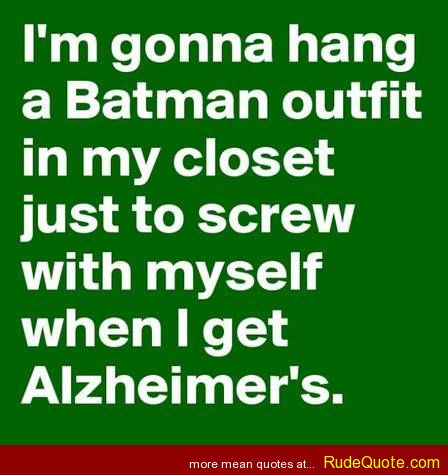
At any rate, it never occurred to me that we could laugh at the horrendous disease. The poster below was the one on the page that I linked below that made me laugh:

So, while laughter isn’t a medicine that cures Alzheimer’s, it’s definitely something to cozy up to and perhaps give yourself a brief moment of life!


Sunday, February 23, 2020

ENCORE #128! – The Reconstruction Era – Part 6


From the first moment my wife discovered she had breast cancer, there was a deafening silence from the men I know. Even ones whose wives, mothers or girlfriends had breast cancer seemed to have received a gag order from some Central Cancer Command and did little more than mumble about the experience. Not one to shut up for any known reason, I started this blog…That was four years ago – as time passed, people searching for answers stumbled across my blog and checked out what I had to say. The following entry first appeared in September of 2013.

“It appears that the next event is breast reconstruction!”

What has amazed me is how INTERESTED people are.

As my wife has had “fills” [Define: “Tissue expansion is a relatively straightforward procedure that enables the body to ‘grow’ extra skin for use in reconstructing almost any part of the body. A silicone balloon expander is inserted under the skin near the area to be repaired and then gradually filled with salt water over time, causing the skin to stretch and grow. It is most commonly used for breast reconstruction following breast removal...”] the size of the expander has increased, creating a place for the actual implant to go once the fills are done.

Couple other things here, one of which is the new name, the other what they “look” like. First the name. My wife has wisely insisted that the surgery is creating “boobs”. These are NOT breasts. Breasts are natural organs that God or evolution designed to feed newborn infants. The “boobs” are cosmetic reconstructions designed to look like breasts and to create the appearance of breasts – and to deflect sympathy and strange looks. They allow a post-mastectomy woman to feel like the other half of the Human race. One plus of the reconstruction – my wife will NEVER HAVE TO WEAR A BRA AGAIN! The boobs are designed to stay exactly where the doctor put them.

Which segues into my second observation regarding what they LOOK like. A few intimate friends of my wife have asked to see them and have marveled at how strange they look. They are, in fact rather like the alien called Odo on the old Star Trek television Deep Space Nine. This alien’s natural form is nothing like Human, so to make everyone around “him” feel more comfortable, “he” has taken on the form of a Human male. “His” face, while recognizable Human has none of the FINE features of a Human face. Odo has eyes, nose, mouth and ears, but only in smooth, featureless outline.

The boobs my wife has are smooth, featureless outlines of real breasts. There is no nipple – though when the surgery is done, the nipples will be added. However, we were informed early on that the areola itself – the dark skin surrounding the nipple – will NOT be recreated. She has to go in…FOR TATTOOS!!!!!!!!!!!!!!!!!! Which are not, of course, covered by insurance as in fact, no tattoos are, being as they are an art form.

“You have GOT to be kidding!” you quip.

I kid you not. I shudder to think what it would be like to go to the nearest certified tattoo artist, walk up to the desk or the multiply-pierced and tattooed associate and say, “Excuse me, I’d like to get an estimate for how much it would cost to get areolas tattooed on my new boobs.”


Saturday, February 15, 2020

ALZHEIMER’S RESEARCH RIGHT NOW! #6: A Dementia VACCINE!?!?!?! (Part 1)

From the first moment I discovered my dad had been diagnosed with Alzheimer’s, it seemed like I was alone in this ugly place. Even ones who had loved ones suffering in this way; even though people TALKED about the disease, it felt for me like they did little more than mumble about the experience. Not one to shut up for any known reason, I added a section to this blog…

Every month, I’ll be highlighting Alzheimer’s research that is going on RIGHT NOW! Harvested from different websites, journals and podcasts, I’ll translate them into understandable English and share them with you. Today: https://www.extremetech.com/extreme/304009-a-new-alzheimers-vaccine-could-be-headed-for-human-trials (This is an online summary of the actual study below).

Too late for Dad, but in time for us?

So, I emailed my doctor about some of the things I’ve written about in this blog, in particular, this post:  “What do these four things have in common: LSDs, Eye Tests, a Video Game, and Blood Tests?” https://breastcancerreaper.blogspot.com/2019/08/alzheimers-research-right-now-3-what-do.html

Here's what I wrote along with his response:

"Dear Dr. Holton:
           "My name is Guy Stewart, and I have some concerns about myself and Alzheimer's. My father died about a year ago from complications resulting from an initial Alzheimer's diagnosis four years earlier. He and my mom eventually moved to assisted living in Maple Grove; and when my mom went on hospice, we used the opportunity to move both into Memory Care. Mom passed, and Dad stayed. I am a writer and science teacher and did much research on dementias. I would like to see if qualify for some early screening advances in the field. The link here is to an essay I wrote regarding some developing research. If you would take the time to skim the links, I'd appreciate it as I would like to see what I can do BEFORE I begin to develop symptoms and it's too late. DON'T rely on the essay -- read the links at the bottom. Thank you." https://breastcancerreaper.blogspot.com/2019/08/alzheimers-research-right-now-3-what-do.html

"Guy,
         "Thanks for the information.  It is very difficult to watch a parent slowly decline from Alzheimer's dementia.  It is a very painful disease process. If you are noting short-term memory lapses, more so than others your age, recommend getting a MoCA test (stands for Montreal Cognitive Assessment).  Our nurses do that at the clinic at Brooklyn Center.  Can just make an appointment with the RN for the MoCA test.  This is quite sensitive and specific for early Alzheimer's type dementia.  Suggest follow-up appointment with me immediately afterwards to discuss the results."

The Health Partners Neuroscience Center in Saint Paul is presently doing several research projects for Alzheimer's type dementia.  I recommend you contact them regarding the most recent research in early detection.  They have the most up-to-date stuff, and perhaps you or family members could be enrolled in their studies.  Good luck and best wishes.”

So, I signed up to be alerted if they are interested in doing Neuroscience studies, in particular, research into stopping Alzheimer’s Disease. (I’ve participated in several studies already! ARIC (Atherosclerosis In Communities); D2D (The effect of vitamin D2 on pre-Diabetes (which earned me a kidney stone…ouch…)); and a couple of other minor ones.

Next time, I’ll talk about the vaccine and its progress. Also, I’ll make an appointment after I retire, to take the MoCA – and I’ll actually report on that test later, in GGTA…Alzheimer’s!

Resources: https://alzres.biomedcentral.com/articles/10.1186/s13195-019-0556-2#Abs1


Saturday, February 8, 2020

ENCORE #127! – The Reconstruction Era, Part 5


From the first moment my wife discovered she had breast cancer, there was a deafening silence from the men I know. Even ones whose wives, mothers or girlfriends had breast cancer seemed to have received a gag order from some Central Cancer Command and did little more than mumble about the experience. Not one to shut up for any known reason, I started this blog…That was four years ago – as time passed, people searching for answers stumbled across my blog and checked out what I had to say. The following entry first appeared in July of 2013.

What I have discovered is that “reconstruction” is an ongoing process. Like The South after the Civil  War, which took many years to recover, my wife is slowly recovering from the surgery, chemotherapy – and now the initial surgery to put in the spacers.

As I’ve documented before, THAT surgery necessitated a few nights of sheer agony, followed by several weeks of rebuilding strength and then regular injections of saline solution in order to stretch the skin so that the ACTUAL implants could be placed some time in November or December.

We are now at some two years and four months after the initial double mastectomy.

Reconstruction in The South took anywhere from twelve to fourteen to “it’s not done yet”…

How long will breast reconstruction last?

Not forever, that’s for certain! There are already signs that things are proceeding apace. After a “triple fill” of saline in the expanders, the increase in size is noticeable and while there’s quite a bit of soreness and tenderness and an obvious sense of stretching involved, there is also a sense of “completion” that I’ve noticed as well.

While we never stopped “winking and butt tweaking” during this time, the winking is now proceeding to raising eyebrows. There’s a sense of a return to normalcy. While doctor visits will be something that will last “forever” as blood tests and other tests will be a part of the new normal, dealing with the after effects of breast cancer have become integrated into life rather than something that happens in panic mode or has to be considered carefully.

While I loathe the path we’ve had to take to get here, I love the fact that we are NOW here!


Saturday, February 1, 2020

BREAST CANCER RESEARCH RIGHT NOW! #71: “Promising Blood Test Could Help to Predict Breast Cancer Recurrence”: My Realistic Re-Write of a Hyperbolic Headline


From the first moment my wife discovered she had breast cancer, there was a deafening silence from the men I know. Even ones whose wives, mothers or girlfriends had breast cancer seemed to have received a gag order from some Central Cancer Command and did little more than mumble about the experience. Not one to shut up for any known reason, I started this blog…

Every month, I’ll be highlighting breast cancer research that is going on RIGHT NOW! Harvested from different websites, journals and podcasts, I’ll translate them into understandable English and share them with you. Today: https://www.hindawi.com/journals/jo/2020/8132507/

I first came across the TIME Magazine article referenced below, with the startling headline, “Promising Blood Test Could Help to Predict Breast Cancer Recurrence”.

As is usual with journalists, the facts are far less likely to get a page turn or site click. In fact, the headline seems to me to be intentionally misleading.

From a more recent article than the one TIME authors chose to base their headline on, the authors point out: “…in principle, tTDS [tagged, targeted deep sequencing, altered to Targeted Digital Sequencing then creatively dubbed TARDIS] is a promising technique for the detection of MRD [minimal residual disease] in BC [breast cancer]. Further studies should assess its use after target design optimization and by increasing the quantity of plasma to be used for ctDNA [circulating tumor DNA] detection. Ultimately, the goal of applying tTDS in early BC is, however, to demonstrate not only its clinical validity, but rather its medical utility. This latter task may lead to effective strategies aimed at altering the course of relapsed disease when detected earlier than clinical progression, and studies directed to this purpose are strongly needed.”

“With the recent possibility of designing custom tTDS panels, which include the most frequently mutated genes in BC, such as TP53, CDH1, GATA3, and PIK3CA hotspots, the use of this method may lead to an effective way to monitor the presence of MRD in a significant proportion of early BC patients.”

“In conclusion, our work showed that, in principle, tTDS is a promising technique for the detection of MRD in BC. Further studies should assess its use after target design optimization and by increasing the quantity of plasma to be used for ctDNA detection. Ultimately, the goal of applying tTDS in early BC is, however, to demonstrate not only its clinical validity, but rather its medical utility. This latter task may lead to effective strategies aimed at altering the course of relapsed disease when detected earlier than clinical progression, and studies directed to this purpose are strongly needed.”

In case you haven’t gathered as much, I am deeply suspicious of a media that intentionally writes at an sixth grade level (based on the Kincaid-Fleishman Scale “…Time magazine scores about 52, an average grade six student's written assignment (age of 12) has a readability index of 60–70 (and a reading grade level of six to seven), and the Harvard Law Review has a general readability score in the low 30s. The highest (easiest) readability score possible is 121.22, but only if every sentence consists of only one one-syllable word. "The cat sat on the mat." scores 116. The score does not have a theoretical lower bound; therefore, it is possible to make the score as low as wanted by arbitrarily including words with many syllables. The sentence “This sentence, taken as a reading passage unto itself, is being used to prove a point." has a readability of 69. The sentence, “The Australian platypus is seemingly a hybrid of a mammal and reptilian creature." scores 37.5 as it has 24 syllables and 13 words. While Amazon calculates “…the text of Moby Dick [is] 57.9, one particularly long sentence about sharks in chapter 64 has a readability score of −146.77. One sentence in the beginning of Swann's Way, by Marcel Proust, has a score of −515.1. The U.S. Department of Defense uses the reading ease test as the standard test of readability for its documents and forms.” (https://en.wikipedia.org/wiki/Flesch%E2%80%93Kincaid_readability_tests

I understand the mission of news documents is to create a reading experience for the public that is approachable to the widest possible audience. But something as important as research into breast cancer treatment…in order to be clear, sometimes it seems that some publishers resort not only to hyperbole, but they allow their reporting to edge into “fake news”.

Based on the academic paper (I admit it’s dense, but I also have a bachelor’s degree in biology and I’m pretty sure most of their writers DON’T) linked below, the researchers say, “…in principle, tTDS is a promising technique for the detection of MRD in BC. Further studies should assess its use after target design optimization and by increasing the quantity of plasma to be used for ctDNA detection. Ultimately, the goal of applying tTDS in early BC is, however, to demonstrate not only its clinical validity, but rather its medical utility. This latter task may lead to effective strategies aimed at altering the course of relapsed disease when detected earlier than clinical progression, and studies directed to this purpose are strongly needed.”

What I would have translated that into is this:

 “Right now, all we’re saying is that TARDIS is a promising way to find tiny pieces of breast cancer DNA in a patient’s blood. We still have lots of testing to do to make it as accurate as possible in finding those pieces. We want to create something that not only works in the lab, but be able to use it as a true test of the chance of a breast cancer coming back – before we find tumors growing in the patient’s body.”

The far less dramatic headline would have accurately read, “Scientists Testing a Way to Find Evidence of Breast Cancer Return BEFORE Tumors Appear” or if you insist, “Promising Research Might Warn Doctors of Return of Breast Cancer”.